
HUMAN INPUT
Hazard and near-miss reports, risk assessments, TBM and equipment signals become one governed Safety Event under human review—linking owner, deadline, action, evidence, residual risk, approval and audit through executive reporting.
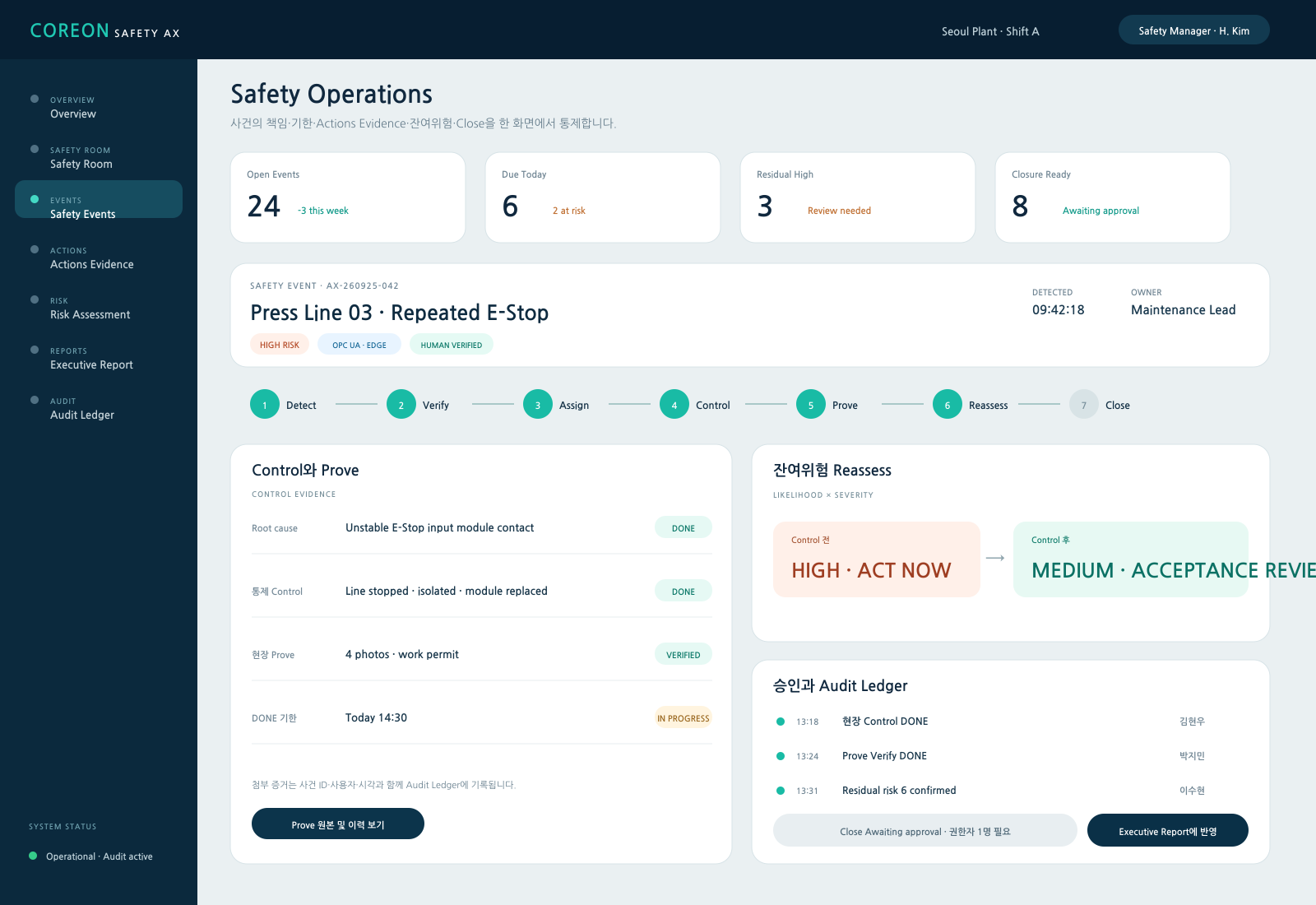
See an external detection signal become a Safety Event, matched with official KOSHA accident cases for reference, then move through human review, owner and deadline, SHA-256 evidence, residual risk reassessment and separation-of-duties approval to a proof of closure — recorded on the actual product.
Recorded on the actual product with synthetic data from a [DEMO] tenant. The opening site CCTV scene is staged, AI-generated footage, and the CCTV AI signal comes from a demo simulator; integration with any specific vendor is confirmed only after field interface validation. The KOSHA accident cases on screen are real public data collected daily by the production server from Korea's Public Data Portal, shown in the original Korean; they are reference material and never change risk or closure automatically. The after-action photo is staged.
Field reports, TBM, inspections and signals from production equipment, mobile assets, sensors and control systems enter a common ingress contract. External signals remain review candidates until an authorized person confirms the operating context.


A first-stage toxic gas alarm in a fab gas room, recreated with a virtual event
COREON does not replace gas detection, interlocks or emergency response and does not control equipment. A COREON closure is not a permit to restart equipment. Brand-neutral scenarios unrelated to any specific customer or manufacturer. Site scenes are AI-generated; product screens are the actual COREON Safety AX recorded with virtual events and data in a demo environment. They do not imply integration, endorsement or contracts with any product or customer; actual integration scope is confirmed after interface validation at the customer site.
Watch on YouTube →Every role sees the work and evidence it needs without losing the shared Safety Event identity or audit lineage.
Critical safety-state transitions pass through evidence, residual-risk and authority checks before authorized closure. When required conditions are incomplete, the workflow remains open for review and corrective action.
AI can classify, summarize and recommend, while final safety judgment, risk acceptance and closure remain with authorized people who review the evidence and residual risk.
COREON maintains Human-Authorized Closure so the record shows who approved closure, on what evidence, and when.
Hazard reports, worker opinions, safety suggestions, reassessments, TBM and reference material retain distinct input types. Only a hazard candidate confirmed by an authorized person becomes a formal Safety Event.
Link risk assessment, TBM, owner and due date, corrective action, before and after evidence, residual risk, preparation, review and approval to the same site case.
Install · start free ↗Use case and approval records to examine open risks, overdue actions and evidence gaps in the executive dashboard, with reports, document control and audit traceability.
Explore the workflow ↗Authorized users can inspect open risks, overdue actions and evidence gaps from field cases. Dashboard and report parity is verified against site data.
So that the executive's safety and health management system does not stop at documents, COREON computes results from the same ledger as field Safety Events, turns shortfalls and gaps into corrective actions, and records confirmation by an authorized person. Only functions verified in production with an internal verification organization in October 2026 are shown.
Register annual safety and health objectives on 14 KPIs; hazard closure rate, overdue items, training completion and budget execution are calculated from records. A different executive approves, a missed target opens a corrective action automatically, and someone other than the completer must verify it.
Required headcount, appointments, qualifications and dedicated assignment are recorded per half-year; a shortfall without a hiring action blocks executive confirmation. Spending beyond the plan is blocked, and shortfall requests are approved or rejected (with an alternative) by a different executive. Appointments, filings and headcount decisions remain with the business.
When a Safety Event requests work authorization, each worker's training history is checked; untrained workers are denied and recorded, and make-up training is planned from the denial. Work stop cannot be lifted and the event cannot close until authorization is granted after training. Beyond the training register, certificates and make-up training, COREON flags action owners with no training record, recent newcomers without training, and recurring hazards that need refresher training, and reports the post-training understanding check rate.
Principal assignment → contractor action and evidence → principal rejection or verification → stop-work request and release are recorded per contractor, and contractors cannot see each other's events. Contractor capability evaluation criteria are on the roadmap.
Occurrence → emergency response and work stop → executive and labor-office reports (receipt numbers) → site control and scene preservation → resume approved by another person → follow-ups → independently verified root cause and prevention → executive closure. Closure is refused while steps are missing, and the closed record is hash-locked. First-aid, medical decisions and statutory reports remain with the business.
Closure time, time to first action, overdue rate, evidence completion, open high-risk items and reopen rate are computed from product records for the baseline (customer records or the same-length period before start) and the pilot, with hash-chained weekly snapshots confirmed by the customer executive. Customer field results are published only after a pilot, and metric changes are not presented as causal effects.
COREON supports recording and confirming procedures. It does not determine legal compliance or guarantee exemption from liability.
We mapped 21 obligations from the Enforcement Decree Art. 4–5 and key Occupational Safety and Health Act provisions as Supported, Partial or Customer-performed. Unsupported items are listed as well.
Objectives and KPIs are computed from records; shortfalls lead to corrective actions and management review decisions, locked when the executive confirms. The policy text is written by the business.
Reports, risk assessments, TBM and equipment signals are recorded as one event through owner, deadline, before/after evidence, residual-risk reassessment and approval.
Improvement execution and residual-risk reassessment are kept as evidence; TBM sharing and field reports record participation and communication.
Field reports and worker opinions are received, and actions and approvals for items confirmed as hazards are tracked.
Actions and evidence for contractor findings are tracked. Contractor capability evaluation is on the roadmap.
This mapping is not legal advice and does not guarantee compliance or exemption from liability. It also includes a clause-by-clause ISO 45001 and KOSHA-MS self-assessment and an internal audit module (ISO 45001 9.2); this is not a certification.
COREON compares ingested and verified KOSHA and other official public references with work, incident and hazard context. Source, version, retrieval date and validation state remain attached so authorized people can use official evidence within the same review and action workflow.
Connect verified comparable cases as reference knowledge.
Preserve origin, version, retrieval date and content hash.
Changed or stale material returns to review so source freshness and approval context can be revalidated before use.
Each sector has its own work language and equipment signals. COREON structures site inputs as reviewable Safety Events and keeps ownership, deadline, action, evidence, residual risk, approval, executive reporting and audit trace on the same event.
Connect risk assessment, TBM, contractor findings and spatial-monitoring candidates to corrective action and verified closure.
Turn equipment anomalies, near misses, AGV·AMR events and worker-route risks into accountable execution records.

Add action, evidence, residual-risk and approval control after HSE, maintenance, alarm and permit-to-work inputs.

Standardize loading, forklifts, hygiene, cleaning and shift handovers while preserving recurring-risk history.

Connect inspections, complaints, works supervision and contractor findings to owners, deadlines, proof, approval and audit reporting.
Preserve existing detection and monitoring strengths, then add human review, accountable action and evidence-led closure.
Standard equipment signals use a common ingress contract. Proprietary signals use an approved, versioned Edge Mapping Profile. Every external signal enters human review, and each live device connection is validated against the actual site interface before production use.
PLC, control panels, switchboards, motors and pumps: run state, faults, emergency stops, temperature, pressure, vibration, overcurrent and alarms.
AMRs, AGVs, forklifts and conveyors: position, speed, proximity, collision risk, stop events and work state.
Gas and fire detectors, access control, CCTV analysis, PPE detection, noise and dust sensors: alerts and inspection findings.
SCADA, MES, WMS and BMS alarms and work data, plus candidates from inspection systems. Interface suitability is assessed for each site.
COREON applies safety-critical engineering principles through verifiable controls, traceability and staged validation.
The pending subject matter covers incident-based cross-system workflow linkage, controlled evidence and residual-risk reassessment. Registered and pending rights are presented separately so customers and partners can review the current IP position clearly.
We review the number of sites, organization structure, safety workflow, integrations and pilot requirements before proposing a deployment plan for enterprise and public-sector customers.
COREON presents product validation and corporate delivery experience as distinct evidence categories, with customer-confidential details protected.
Actual supply performance with a major Korean construction company supports COREON's enterprise transaction and delivery capability.
Paid electrical-construction consulting in a U.S. industrial field supports COREON's global field understanding and delivery experience.
Questions we are often asked before adoption.
COREON does not provide legal advice or any exemption from liability. It records risk assessments, TBM, corrective actions, evidence and approvals as one event, so executives and safety managers can check whether the safety and health management system was actually carried out. See the law mapping for scope by provision.
Risk assessments, field reports and equipment signals are grouped into one Safety Event and linked to an owner, deadline, corrective action, before/after evidence and residual-risk reassessment. An event cannot close without the required evidence and approval.
COREON provides a standard REST/Webhook contract; OPC UA, Modbus and MQTT signals connect through an edge gateway. The actual integration scope is confirmed after interface testing in each customer environment.
You can install Safety AX for free from this site. Multi-site, enterprise and public-sector scope is agreed through consultation.
COREON HOLDINGS develops industrial-safety technology and COREON Safety AX Agent for verifiable safety execution.